The Secretary-General of the Gulf Cooperation Council (GCC), Jassem Mohamed Al-Badiwi, stated that the joint GCC ministerial meetings with Jordan, Egypt, Morocco, and the United Kingdom, held separately, have achieved positive results in enhancing relations between the parties. He praised their supportive and steadfast positions in standing with the GCC states against Iranian aggression.
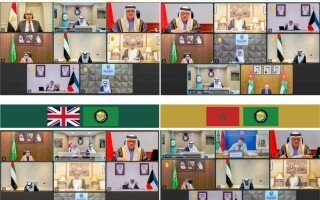
Yesterday, February 19, 2026, joint ministerial meetings were held between the GCC and the Hashemite Kingdom of Jordan, the Arab Republic of Egypt, the Kingdom of Morocco, and the United Kingdom, separately, via videoconference. The meetings were chaired by the Minister of Foreign Affairs of the Kingdom of Bahrain, the current Chairman of the Ministerial Council, Dr. Abdullatif bin Rashid Al-Zayani, and attended by the foreign ministers of GCC countries.
The Secretary-General noted that these meetings took place against a backdrop of a serious and unprecedented escalation in the region due to the unprovoked Iranian attacks targeting GCC states and the Hashemite Kingdom of Jordan since February 28, 2026. These missile and drone attacks have resulted in civilian casualties, significant material damage, and a blatant violation of international law and the principles of the international system based on respect for state sovereignty and territorial integrity.
He also commended the strong solidarity expressed by these brotherly and friendly countries against the criminal Iranian aggressions and their support for the measures taken by the GCC states to defend their sovereignty, security, and stability.
The Secretary-General confirmed that these joint meetings clarified that the danger of these aggressions is not limited to the security of the GCC states but extends to threaten the security of international navigation in the Strait of Hormuz, one of the world's most important strategic maritime passages. Attacks on commercial vessels and vital sea lanes pose a direct threat to the freedom of international navigation and expose global trade and energy security to severe risks, which could have negative repercussions on the global economy and the stability of international markets.
He pointed to the joint meetings' welcome of UN Security Council Resolution 2817 (2026), adopted by 136 countries, which condemned in the strongest terms the heinous attacks launched by the Islamic Republic of Iran on the territory of the United Arab Emirates, the Kingdom of Bahrain, the Sultanate of Oman, the State of Qatar, the State of Kuwait, the Kingdom of Saudi Arabia, and the Hashemite Kingdom of Jordan. The Security Council affirmed the right of the GCC states and Jordan to the right of individual or collective self-defense in accordance with Article 51 of the UN Charter, calling on Iran to immediately cease all attacks and refrain from any provocation or threats to neighboring countries.
It was also mentioned that during these joint meetings, ways to enhance relations were discussed, as well as several current and future projects being worked on with brotherly and friendly countries for mutual benefit.
The Palestinian issue was recalled during the meetings, with the Secretary-General affirming that it remains at the core of our common priorities. He praised the strenuous efforts made by the GCC states and the Arab Republic of Egypt to end the war on the Gaza Strip, and confirmed our firm support for the implementation of the Peace Council's tasks in accordance with the comprehensive plan to resolve the conflict, paving the way for a just and lasting peace.
Furthermore, during the GCC-Morocco meeting, the GCC Council renewed its firm stance regarding the territorial integrity of the Kingdom of Morocco, welcoming UN Security Council Resolution 2797, which enshrined Moroccan autonomy under its sovereignty as the sole basis for resolving this regional conflict.
The Secretary-General explained that the joint meetings with brotherly and friendly countries also embodied the importance of the strategic partnership between the parties in facing common security challenges, which require continued coordination and cooperation, believing that diplomatic solutions and constructive dialogue remain the best way to address crises, foremost of which is the current crisis in the region.